Quote scope for three site types
Each site changes what belongs inside the module cell and what must sit beside it. The desk records the split. It does not choose the site design.
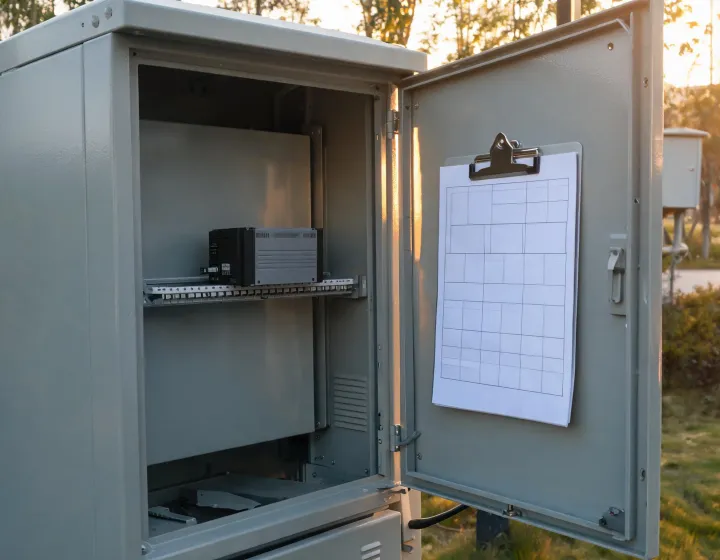
Shelter cabinet
An outdoor shelter often asks about ingress protection and a temperature band. Ask the supplier for the code on the exact model, not on a sibling brick. A convection body and a fan body can share 24 V and 10 A and still diverge at 50 °C. Frequency range on an AC inlet is usually a 50 Hz and 60 Hz question when the feed is 100-240 VAC.
Indoor rack
A rack unit is 44.45 mm. Ask for shelf height only when the supply is a rack module. A shelf brick and a wall brick are different drawings. Airflow direction matters when the rack is already packed. Power over Ethernet on a nearby switch is a port load, not this brick’s output.
Radio cabinet
Some radios state a narrow input window around 24 V. Ask the host manual for the minimum and maximum before a substitute is accepted. Impedance, if the radio vendor wrote milliohms, belongs in its own cell. Connector mating cycle matters when the inlet is unplugged during maintenance. Runtime stays blank unless a battery string shares the purchase.
What the price cell may contain
- Currency, and whether the figure is per module or for the whole order.
- Quantity that the figure covers, including a sample of 1 and a lot such as 30.
- Incoterm, freight, and duty as neighboring cells, not as hidden extras inside the module number.
- A calendar day for the quoted ship window, for example 2025-11-18, tied to that quantity.
New brick versus a refurbished spare
Side A, new: a new 24 V 10 A brick can make the safety file and the support path easier to read when the cabinet will stay in service for years. The buyer still has to match the drawing to the hole pattern. Side B, refurbished: a refurbished unit can be the practical path when the original footprint is discontinued, if condition notes, a test date, and warranty months are written. LinkScope Sourcing 49 does not rank either path. The form’s preference control is the buyer’s choice, not a verified grade.
Vendor-labeled supply versus a form-fit supply
Side A, a vendor-labeled module: it may line up with the radio maker’s support policy when that policy names the supply. Ask for the label, the model, and the current file. Side B, a form-fit supply from another maker: it may widen the set of factories when pinout, regulation, and cooling are checked against the host. A matching watt number is not that check. Measurement accuracy of a panel meter, and calibration traceability of the meter used at incoming inspection, stay on the acceptance plan. This desk does not run that test.
Background: a tower crew compared three 24 V replies for one outdoor cabinet. Process: the desk split the 240 W nameplate, the fan kit, a 2 m cord, and freight into four rows and asked each factory for the datasheet day, such as 2024-09-09. Result: one reply was a 12 V unit plus a separate boost stage, so it left the 24 V set. The scene is a procurement situation, not a published saving.
Switching capacity and forwarding rate stay off this price sheet. Those words describe a switch fabric. Optical budget is a fiber question. The India TEC infrastructure list, used only as question context under reference-tec-telecom-infrastructure, does not certify a US shelter. FCC equipment authorization and an NRTL file are requested only when they name the model.
Read the inquiry rows and the 12 V line workflow when a cabinet mixes voltages. Send the site sheet through the form.