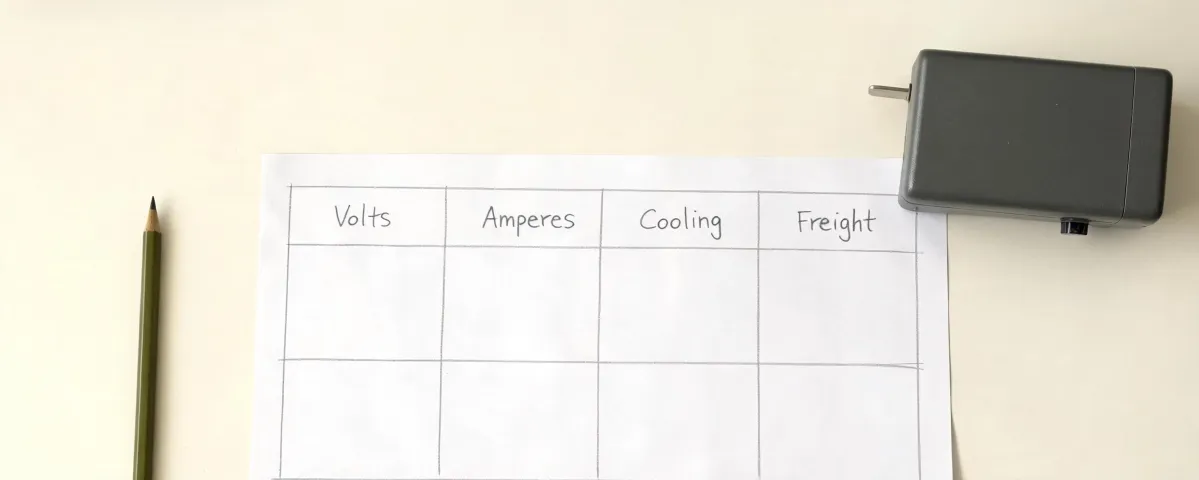
Evidence ledger each supplier reply should complete
Ask for a datasheet day, for example 2024-11-03, next to the model. A brochure dated in a different year cannot stand in for that row. The buyer note published 2026-10-27 uses the same rule.
| Row | What the supplier writes | What stays out of the cell |
|---|
| Identity |
Maker, model, and the exact output: 12 V at 10 A (120 W) or 24 V at 10 A (240 W). |
A family name that covers several wattages. |
| Input |
100-240 VAC at 50 Hz and 60 Hz, or -48 VDC, plus the inlet or lug. |
A photo of a cord that is not in the quote. |
| Cooling |
Fan or convection, airflow, and the curve at 40 °C and at 50 °C. |
A room-temperature banner with no ambient stated. |
| Evidence |
Current datasheet, drawing, and any safety file that names the model. |
An NRTL or FCC claim that does not cite the model. |
| Money scope |
Currency, per-module or whole-order basis, Incoterm, freight, and duties. |
A headline number that hides the cord and the shelf. |
Measurement accuracy belongs on a meter line. Calibration traceability is requested only when acceptance uses that meter. Connector mating cycle is requested only when the inlet is a wear item. Impedance, in milliohms, is requested only when the radio vendor wrote it into the host spec. Rack unit height is requested for shelves: 44.45 mm per unit. Runtime is requested only when a battery string is in the same order.
New module versus refurbished module
Side A, new: a new build can make the support path and the safety file easier to read, and the buyer may prefer it when the site will run for years. Side B, refurbished: a refurbished unit can be the practical path when a legacy footprint is discontinued, provided condition, test notes, and warranty months are written. LinkScope Sourcing 49 does not grade either path. The preference control on the form is the buyer choice, not a verified rank.
Background: a regional operator compared four supplier sheets for enclosed 24 V bricks. Process: the desk moved fan kits, shelf rails, and freight into their own rows and required the 240 W figure beside the model. Result: two sheets that looked compact were 12 V 120 W units plus a separate converter, so they were not compared as 24 V bricks. This is a procurement situation, not a customer award.